boardspace.net


The Rules for Bugspiel

OBJECT OF THE GAME
 
Score the most points by playing bugs and bonus cards.    
The general flow of the game is that you purchase bug cards and bonus cards from the market, paying with victory points.
New cards start at high cost, and become cheaper over time if they are not purchased.
The value to play a card is some number of victory points.
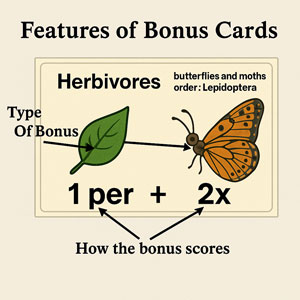
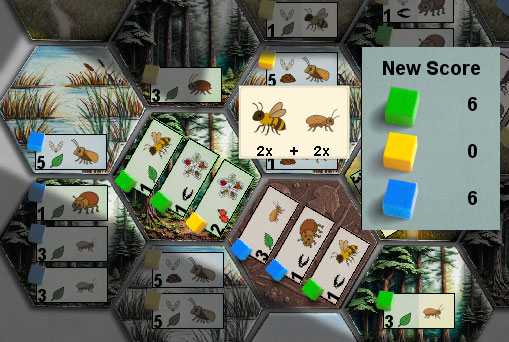
The value to play a bonus card depends on matching the group and/or habitat of cards in the same uninterrupted line.


Components
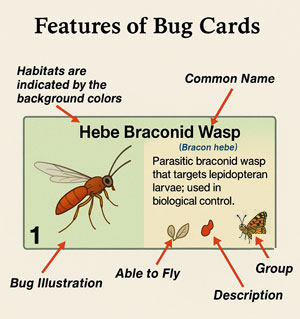
  • Bug Cards, each card represents a species of invertebrate. 
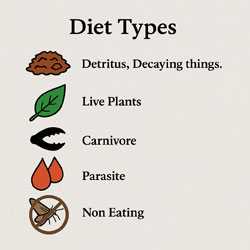
  • Bonus cards are associated with groups of species, diet, or flying ability.
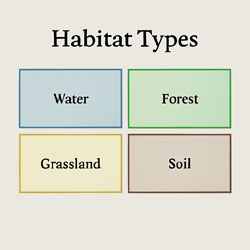
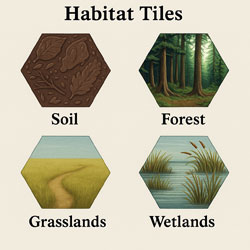
  • Hexagonal "Terrain" Tiles of  4 types: Aquatic, Soil, Grassland or Forest
  • Victory Points are the only currency in the game.  Buying cards costs victory points,
    and playing cards gain victory points.
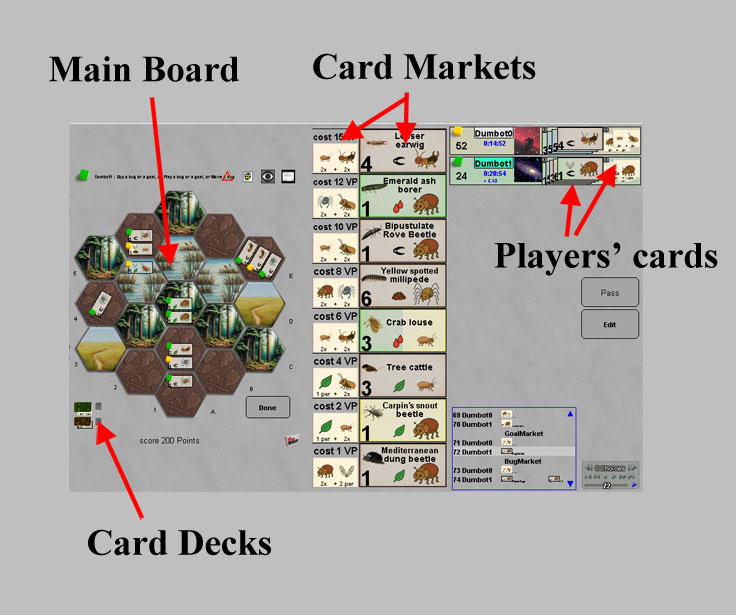
  • The market holds 8 bug and 8 bonus cards at increasing prices.
bugcard
bonus
habitat
tiles
diet
 Set Up:
  • A few random categories of bugs are selected, enough to make a bug deck.  All the bug cards from those categories are shuffled together to create the bug deck.
  • The bonus deck is created using proportional numbers of bonuses for each category of bug.
  • Each player gets 1 random low value bug and 1 random bonus card.
  • Board tiles are selected in a proportion appropriate for the habitats of the bugs in the deck, and arranged randomly to form a board.
  • The bug market and goal market are filled with random bugs, except that bugs that are too immediately profitable are shuffled back
    into the deck - there are no "no brainer" cards in the initial offering.   Note that in some randomly created decks, the lowest
    value bug might be 2 or 3 points rather than 1 point.
main

Turns:
The game is played in a number of turns, each turn you can do one of the following things:
End of Game:
The game ends when everyone passes sequentially, or when there are vacant slots in the bug or bonus market,
or when a the winning score is reached.

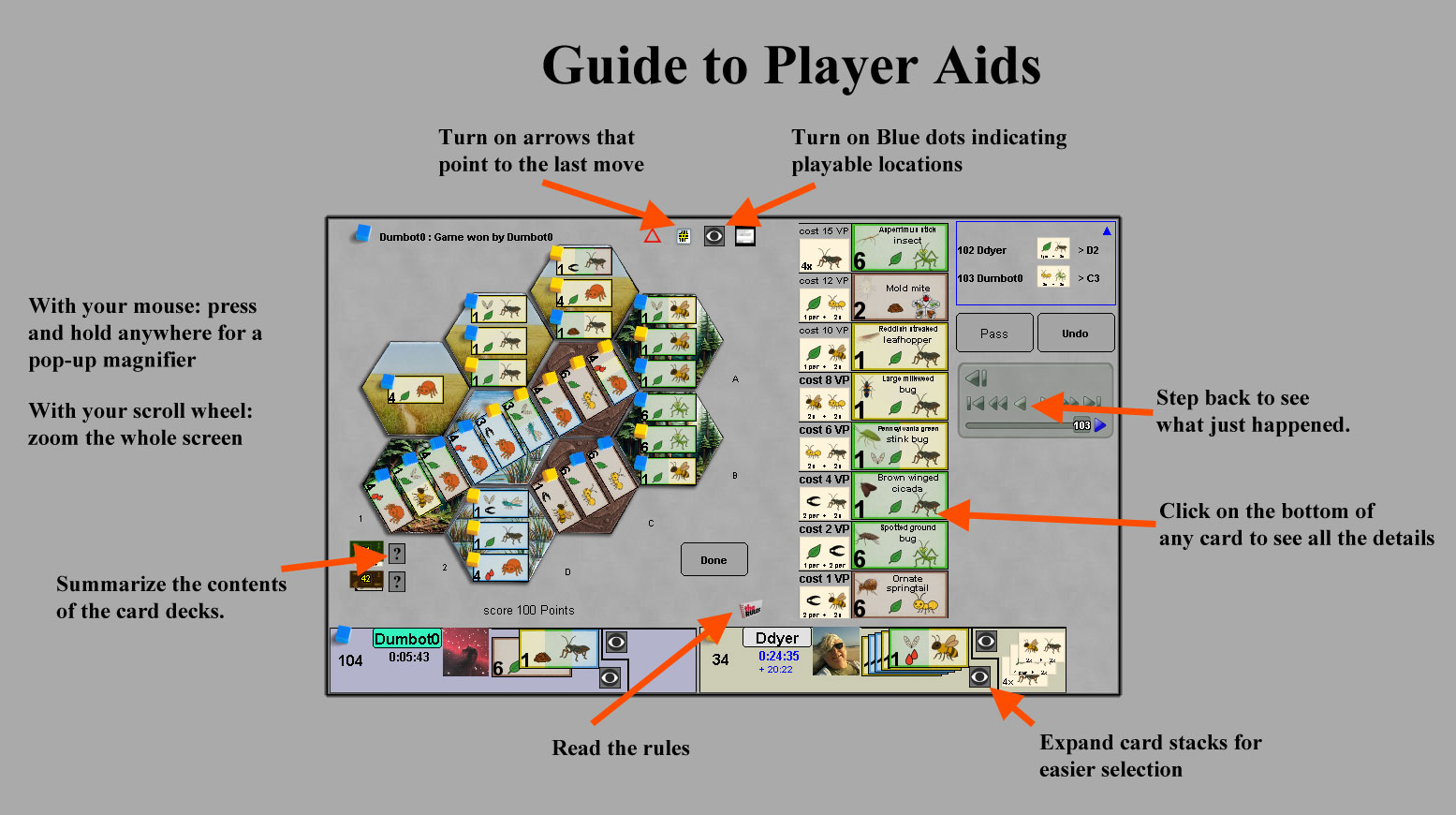
helps
Intended Strategy Considerations
Scientific Accuracy   :  the deck
The strict accuracy of the information implied by the card is desired, but not guaranteed.  Starting with the
scientific name (Genus + species), ChatGPT, Google search, and other AI assistants were used to find the
common names, place the species in the proper place in the scientific taxonomy, generate the illustrations,
the descriptions, the acceptable habitats and so on.    All of this information was curated  and corrected
with ordinary scientific knowledge and human intelligence.   I was unable to locate an entomologist who
wanted to spend hundreds of hours on a free project.  There are a lot of gray areas, but if you spot
something that's obviously incorrect, please send suggestions to bugspiel@boardspace.net.

Design Notes:

As noted elsewhere, this game is inspired by Wingspan; but I wanted to make a game with a lot
more player interaction.  Consequently, there are no secret goals, no hidden information, and
plenty of opportunity to play to thwart your opponents as well as build your own engine.

Also, because this is intended to be a digital-only game, there are features of the game that
would be hard to replicate in a physical version.  For example, the cards have 4 different
styles of presentation, depending on where they are displayed and how large they are. For
another, the randomization of the setup is much more detailed than could reasonably be
done for a physical game.  For another, the scoring of bonus cards would be tedious
and error prone if it were not completely automatic.


E-Mail: Go to BoardSpace.net home page